• 29 Oct 2012 /  Uncategorized

    This year for Halloween I made another paper mache helmet, in the style of Dennis McNett at wolfbat.com I’m really pleased with the results of this one.

    Also, I’ve been taking photos of all the work I’ve been up to since my last post, and it is quite a lot.  I’ll be posting it up gradually over the next few days.

  • 12 Mar 2012 /  Uncategorized

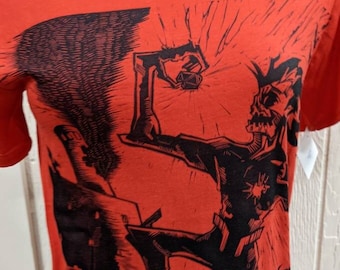
    My printed t-shirts are now available at the Switch House, near downtown Huntsville.  It’s a really cool store, with all the goods made by local Huntsvillains.  If you like my art work, you’ll like a lot of their stuff.


  • 20 Dec 2011 /  Uncategorized

    Ameressiah - flying Kick


    Initiate Love


    According to a very inebriated woman I met this last weekend, this is the sort of thing you like.

    Both of these are on shirts now, see more at the Etsy store.

  • 20 Jul 2011 /  Uncategorized

    I’ve now added a page just for the prints that make for nice shirts, all of which are now available at the Etsy Store.

    There’s also a new print:

    Lovecraft Lucha Libre

    It’s a big one at 12×19, and I love it but I’m not sure it’ll fit on a shirt.  We’ll see.

  • 20 Jul 2011 /  blog, rant, Uncategorized

    This is just me ranting about a theory I have.  Art will come of this shortly.

    We’re seeing a lot of crime solving dramas on TV these days.  There’s always been a few, certainly, but the trend has been growing for awhile now.  Off the top of my head, there’s the CSI and Law & Order franchises, Monk, Castle, Bones, Psyche, Criminal Minds, Pushing Daisies, Dexter, Bored to Death, Sherlock, Cold Case, the list goes on.  It’s gotten to the point where people feel like they feel informed about the justice system from television, and prosecutors now have to compensate for a jury’s expectations of evidence that they get from television.

    I wonder why people like these shows so much.  I think some of the appeal has something to do with seeing criminal offenders brought to justice.  It’s very rare to see an episode of these shows where a bad guy gets away, or simply no suspect is identified.  Which is closer to reality, but I don’t think this is just about criminals.  In the last decade, we’ve had the potential to be more informed than ever before about all the problems in our lives and in our culture, and civilization itself.  These major problems in our culture are endlessly explored and explained in every media format.  But when we have all of this data, it overwhelms us.  It’s rarely the case that the unemployment rates or the fate of the space program or debt reduction has a villain that we can apprehend and put away forever.  Scandals are everywhere, but more often than not we see no guilty party.  We had a president steal an election, his underlings broke the cover of a CIA agent, white collar criminals stole billions of dollars and ruined people’s lives, two wars began with no sign of ending, our economy collapsed, our education system continued to lag behind, we still have no energy strategy, all of this – and there are no bad guys being punished.  The problems are systemic, not just deeply complex but wide, there’s so much data to process.  The dilemmas are simply too big to comprehend, much less actually solve.  But we wish it could be like Scooby Doo, where all the bank collapses are because of old Mr Beaton, dressed up as a robot scarecrow. Take him away!

    It’s harder to understand all of the data we have because there’s so much of it, and we have trouble prioritizing good information over the bad.  We’re struggling to deal with the notion that we don’t really have “facts” anymore.  We’d like to have them, but no matter what your position, there’s all this other information that disagree with your conclusion, and they’re “facts” too.  It’s a fact that Barack Obama was born in Kenya and smuggled into the country.  And Paul Revere rode through town firing warning shots at the British telling them they wouldn’t take our guns and freedoms.  It’s a fact now.  No matter that we have birth certificates and actual history documented by historians that contradict these ridiculous ideas.   We have people who cling to these ideas as truth.  To them, this is reality.  They have their own information to back it up.

    We have people, frequently labeled as experts, declaring the legitimacy of almost any arrivable conclusion.  The media, especially television, reduces credibility of an expert to a title bar beneath a talking head, but when every expert is equally credible, every expert on every side is just as good as any other.  But these different experts all have different facts, so we pick a news outlet that has a narrative we like and we decide that their facts are the best.  I want to believe that ethanol is a good idea, so only the facts that fit this worldview presented by my preferred experts will make it past my media filters.  We will only read the websites or watch the news shows that give facts that conform to my world view.  This filtering is how we cope with the flood of information we have access to, but which we cannot process or comprehend, to make a purely objective conclusion. Reality is now determined by Colbert’s “truthiness,”   by gut instinct and bias and the inclination of previously held belief.

    With this new subjective reality, how can we be expected to fix our economy? It’s a fact now that the New Deal was a terrible idea and didn’t work.  The budget deficit only matters if your political party is in the minority.  Tax cuts for the rich will cause money to trickle down to the lower classes any day now, just you wait.  The debate for a solution is rich and complex, but we have our experts to guide us.  Unfortunately, when we tout our evidence and present our experts, they are refuted by all the other contradicting facts and experts, and no one’s mind changes.  Facts are now based on opinions, and we cannot assert the strength of one opinion over another.  Eventually, we shrug and retreat, maintaining our bias, and our filtered information, and conclude that the opposition is simply clueless and doesn’t understand because they have bad facts.

    But when we want entertainment, we want to escape this problem, so we want a fantasy about a dilemma that will be solved, quickly, definitively and without compromise.  So we want to watch a TV show where someone commits a crime, but smart people uncover all the facts and evidence, they discover the truth, track down the guilty party and catch them.  And the villain goes away forever, never to return.  There’s no parole or tax loops or bribes or presidential pardons on CSI to let the villain escape.  Justice actually gets served – on television, anyway.

    Tags: , , , , , , , , , , ,